
Stay updated with the latest activities, projects, and achievements of Emerson CoE. From ongoing studies to collaborations, events, and publications, this section highlights our work in tackling key environmental challenges.
Building Leadership for Carbon Neutrality (Net-Zero) in Higher Education Institutions
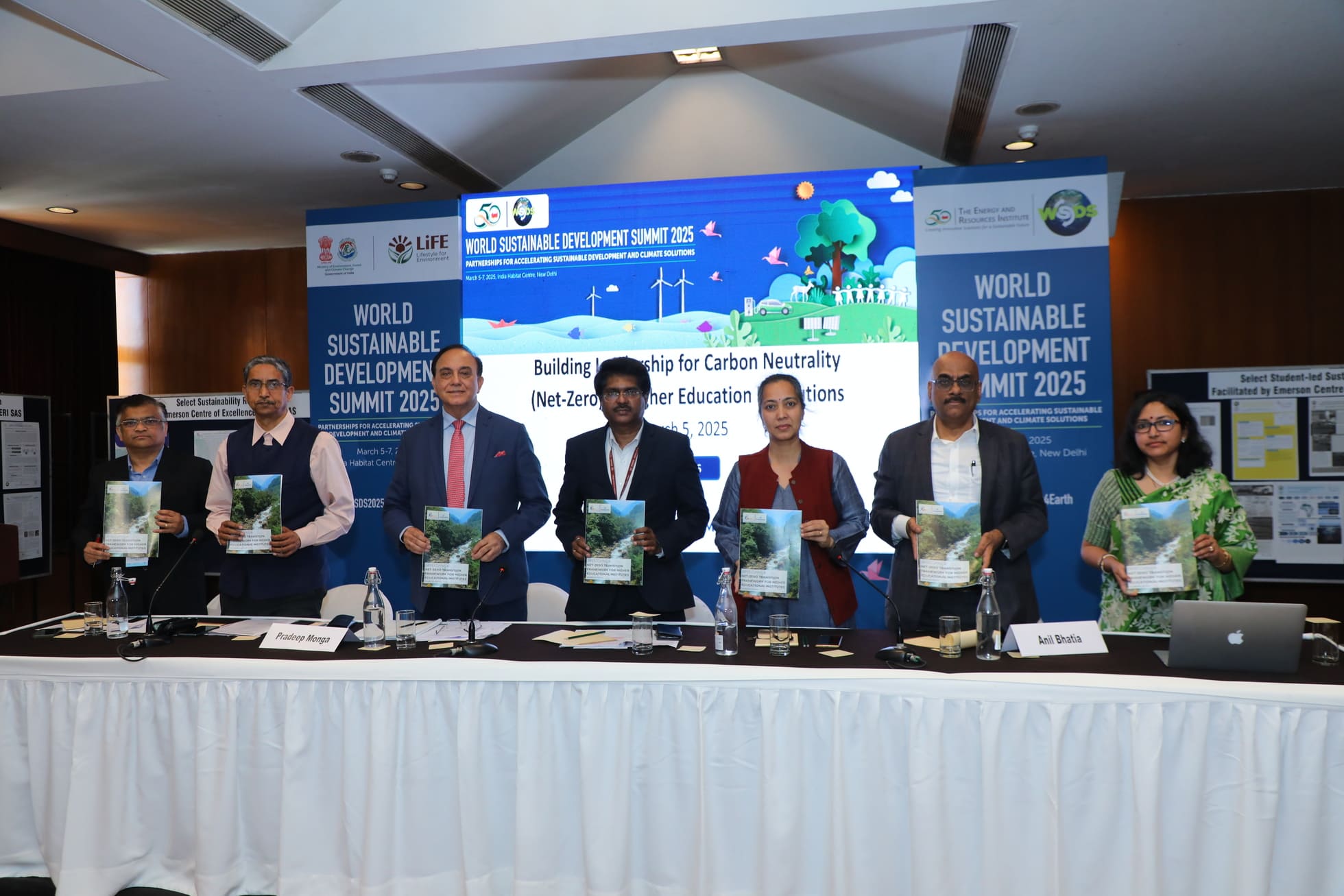
The Emerson Centre of Excellence for Sustainability Studiesat TERI SAS organised a high-profile thematic track on “BuildingLeadership for Carbon Neutrality (Net-Zero) in Higher Education Institutions” at the 24th edition of the World Sustainable Development Summit 2025. Through this initiative, TERI SAS seeks to drive capacity building and leadership in HEIs to chart out pathways to attain carbon neutrality. The Thematic Track was welcomed by Dr Suman Kumar Dhar, vice Chancellor of TERi School of Advanced Studies. The session was moderated by Prof. Dr. ShaleenSinghal (Director, Emerson CoE, TERI SAS), who emphasised the importance of a net-zero framework for maximising positive impacts across HEIs.
Mr. Anil Bhatia (VP & MD, Emerson-India) put forth the perspectives of corporate stakeholders, noting the trilateral approach of “greening by, greening for, and greening with” as a feasible approach to carbon neutrality in the context of various stakeholders. Dr. Pradeep Monga (International Institute for Applied Systems Analysis, Vienna) spoke on the importance of a systems approach, in stark contrast to the silo approach still being adopted in most scenarios. Dr. Priyanka Kaushal (CDRT, IIT Delhi) enumerated IIT Delhi’s commitment to net-zero through interventions in the domain of energy, mobility and resource management. Mr. S. Rajesh (Inspector General of Forests, MoEFCC) expressed that the Indian government is catalysing innovative projects and roadmaps for HEIs to help in the achievement of India’s nationally determined contributions under the Paris Agreement and the Panchamrit pledge of net-zero by 2070. Dr. Suman Kumar Dhar (VC, TERI SAS) proudly spoke about a unique carbon capture pilot prototype at TERI SAS, capable of capturing 500 kg of carbon dioxide per year through a novel nature-based pathway, developed by TERI SAS research scholar Souryadeep Basak, SRF. He also emphasised the need for institutional planning to anticipate and account for future growth trajectories. Mr. Sagarmoy Phukan (Research Fellow, Emerson CoE) presented a high-level framework for HEIs to have a pragmatic roadmap for achieving net-zero status within achievable timelines. The event was concluded by the vote of thanks delivered by Dr. Sukanya Das (Dean, Research and Partnerships).
More than 21 students from post-graduate courses across various disciplines and representatives from 10 HEIs attended the event. The HEI representatives were optimistic at the prospect of the net-zero framework development and were hopeful for joint implementation of sustainability measure in collaboration with Emerson CoE, TERI SAS.