
ANNOUNCEMENTS

| Date | News Title | Source |
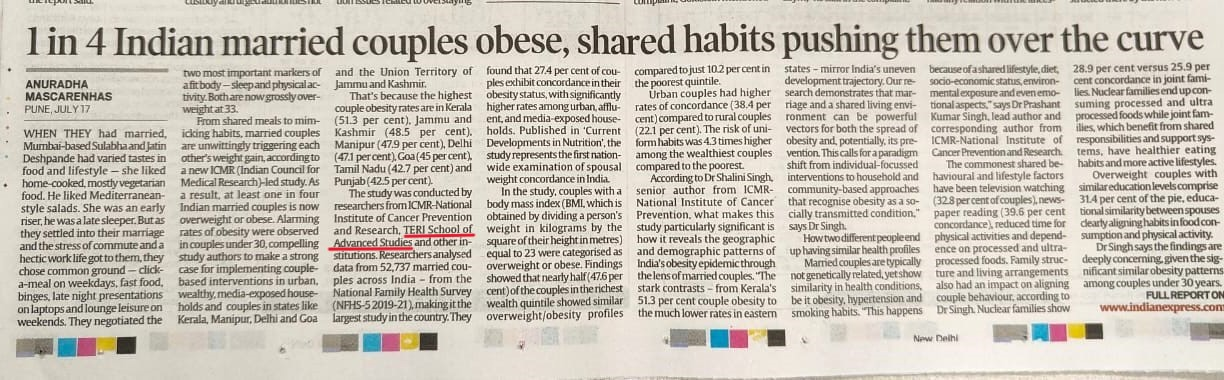
| 18-July-2025 | 1 in 4 Indian married couples ... | The Indian Express |
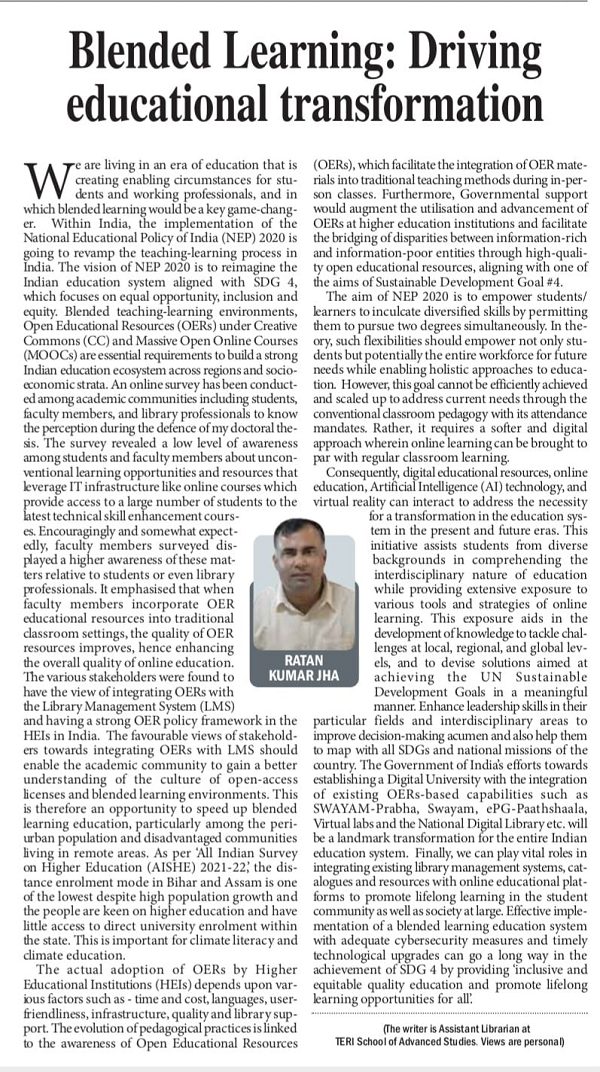
| 23-June-2025 | Blended Learning: Driving educ... | The Pioneer |
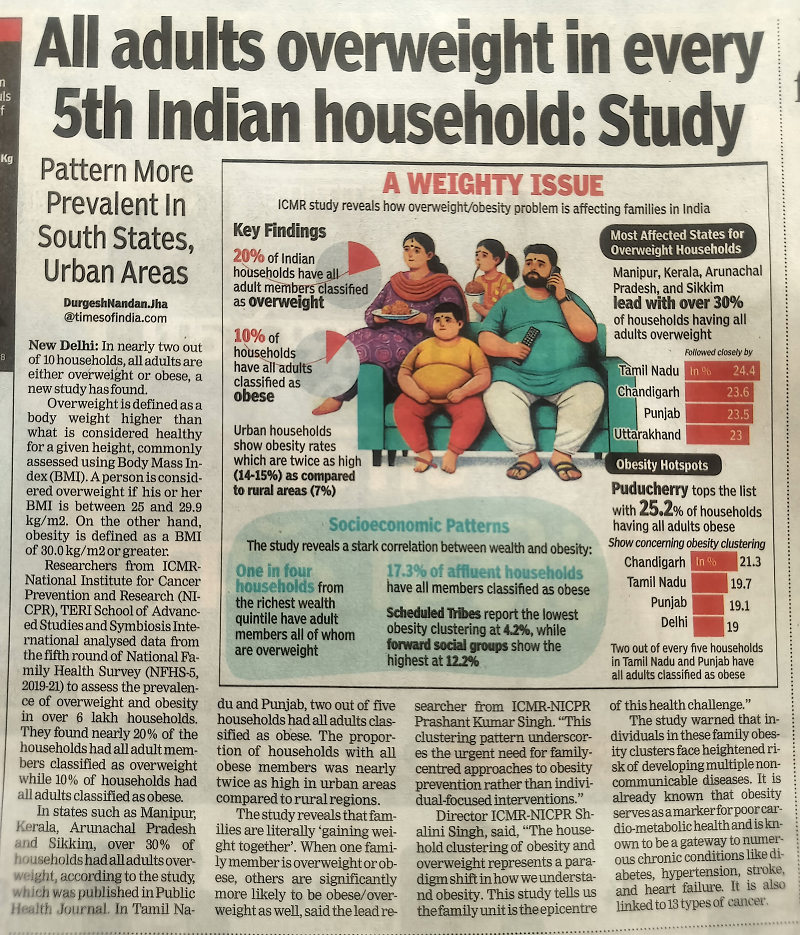
| 22-June-2025 | All adults overweight in every... | |
| 21-June-2025 | TERI SAS Nurturing Global Sust... | The Interview World (Online) |
| 27-May-2025 | Eco-education trend grows: Sus... | India Today (Online- Education Desk) |
| 25-March-2025 | How water green credits can fu... | Hindustan Times (Opinion) |
| 23-February-2025 | Sustainable biz practices disc... | The Times of India (Online) |
| 21-February-2025 | Sangam fit for bath’, Enviro... | News9 (Online) |
| 12-February-2025 | A role for India in South-Sout... | The Hindu (Online) |
| 02-December-2024 | ICAR Findings Show 34% Decline... | ETV Bharat (Online) |
Founded in 1998 by The Energy and Resources Institute, TERI School of Advanced Studies (TERI SAS) has emerged as a leading institution dedicated to sustainability-driven education and research. Granted the status of a “Deemed to be University” in 1999, TERI SAS operates from a state-of-the-art green campus in Vasant Kunj, New Delhi. Engineered for optimal energy and water efficiency, the campus incorporates cutting-edge innovations—such as the Earth Air Tunnel and thermal mass storage systems—resulting in a 60% reduction in energy consumption and a 25% drop in water usage.
TERI SAS offers a comprehensive suite of undergraduate, postgraduate, and doctoral programs, all approved by the University Grants Commission (UGC) and accredited by the National Assessment and Accreditation Council (NAAC). Beyond national boundaries, the institution collaborates with globally renowned universities including Yale, the University of New South Wales, and the University of Nottingham, fostering a rich ecosystem of academic exchange, research, and innovation.
In an exclusive conversation with The Interview World, Prof. (Dr.) Chander Kumar Singh, Professor and Dean (Academics) at TERI SAS, offered a deep dive into the institution’s strategic initiatives and academic strengths. He detailed the university’s flagship programs, outlined the transformative changes implemented in line with the National Education Policy (NEP), and explained how TERI SAS is embedding disruptive technologies into its pedagogy and research.
Moreover, Prof. Singh highlighted the robust employment pathways available to graduates, emphasized TERI SAS’s active role in advancing both national and global sustainability goals, and reaffirmed the institution’s strong commitment to inclusion and diversity. He also spotlighted the university’s expanding global partnerships that enrich the academic experience and broaden student horizons.
Here are the key takeaways from this insightful exchange.
Q: What programs does TERI School of Advanced Studies offer for students pursuing careers in environment and sustainability—an increasingly important and in-demand field today?
A: Let me give you a quick overview of the unique academic offerings at our institution. Originally established as a postgraduate and research-driven university, we transitioned into undergraduate education a few years ago in alignment with the National Education Policy (NEP). Since then, we’ve introduced several new bachelor’s programs.
What sets us apart is our distinct academic focus. Unlike most universities, we don’t offer conventional courses. Instead, our programs are deeply rooted in sustainability and environmental policy—reflecting our legacy in this space. Some of our flagship programs include a Master’s in Climate Science and Policy, a Master’s in Sustainable Development Practice, and a Master’s in Public Policy and Sustainable Development. These programs cater to highly specialized and emerging fields.
TERI’s strength lies in its five-decade-long commitment to sustainability and environmental research. This extensive experience gives us an edge over newer institutions that are only now beginning to explore these areas. In fact, we’ve been offering many of these niche programs for over 26 years, long before sustainability became a mainstream academic trend.
Our unwavering focus remains on environmental issues. We have never strayed from our core mission. This commitment is evident in our dynamic curriculum, which undergoes revision every two years. We continuously update course content based on the latest developments and global discourse in climate science, natural resource management, and environmental policy.
Our programs span key thematic areas such as natural resource management, water governance, environmental health, and public health as it relates to the environment. Recently, we launched a new program in Energy Science and Management. Building on our leadership in the energy sector, we are also introducing a Bachelor of Science in Energy and Computer Applications—another innovative offering that aligns with TERI’s core strengths.
In essence, we don’t follow the traditional academic path. We offer future-focused programs grounded in real-world relevance and designed to create leaders in sustainability and environmental innovation.
Q: What changes have you introduced to your curriculum or academic programs in alignment with the National Education Policy (NEP)?
A: The National Education Policy (NEP) came into effect in 2022—and we were among the first institutions in the country to fully implement its guidelines at the undergraduate level. That same year, we launched our bachelor’s programs, designed from the ground up to align with NEP’s progressive vision. While our postgraduate programs remain governed by the earlier framework for now—since it will take four years for the first undergraduate cohorts to transition—the groundwork for future compliance is already in place.
Our undergraduate curriculum is 100% NEP-compliant. Every element reflects the flexibility, interdisciplinarity, and skill-based learning that NEP emphasizes. Students can customize their academic journey. For instance, one can pursue a BSc with a major in Environmental Studies and a minor in Data Science. Alternatively, a student interested in Data Science as a major can combine it with a minor in Management—provided they complete the requisite 35 credits for the chosen minor.
We’ve built this flexibility deliberately, drawing on our institutional expertise, decades of applied research, and real-world case studies. Each course integrates hands-on experience and value-based learning, in keeping with NEP’s emphasis on skill development, practical exposure, and holistic education.
Importantly, our curriculum remains dynamic. We continuously refine it based on ongoing feedback and interaction with our students, who come from diverse academic and cultural backgrounds. We don’t believe in static course structures. Instead, we evolve our programs in real time, tailoring them to meet the emerging needs, aspirations, and learning styles of our students.
In essence, our approach to NEP isn’t just about compliance—it’s about leadership. We’re not merely adopting policy; we’re actualizing its intent through thoughtful design, academic innovation, and an unwavering commitment to student-centred learning.
Q: With disruptive technologies transforming various fields, including environmental studies, how is TERI SAS integrating these technologies into its academic and research programs?
A: As I mentioned earlier, environmental education thrives on real-world case studies—and that’s where our programs truly stand apart. Unlike many academic institutions that rely heavily on theory, we embed experiential learning directly into our curriculum. This approach is possible because our parent organization, TERI, has been a pioneer in sustainability and environmental research for over 50 years. As the academic arm, now in our 26th year, we have access to a vast repository of field-based insights and case studies developed through TERI’s extensive on-ground work. These form the backbone of our teaching methodology.
Rather than teaching sustainability as a purely theoretical subject, we ground it in lived experiences and field-based research. Our students learn directly from real projects, gaining a deeper, more applicable understanding of environmental challenges and solutions.
At the same time, we actively integrate emerging technologies into our curriculum. Take, for instance, our course in Geoinformatics. Six years ago, foreseeing the rise of artificial intelligence in environmental monitoring, we introduced a specialized course on Geocomputation. This forward-thinking program—rarely offered elsewhere in the country—trains students to apply AI in satellite data analysis and natural resource management.
Encouraged by the enthusiastic response from our tech-oriented students, we expanded the integration of AI across various programs. Today, even students in our master’s programs in Climate Science and Policy or Environmental Studies can opt for elective courses in AI and machine learning. Recognizing that not every student gravitates toward technical subjects, we’ve kept these as flexible electives. However, the shift is clear—data science and digital technologies are now central to sustainability education.
This vision also led us to launch a full-fledged undergraduate program in Data Science, tailored specifically for students in the environmental domain. Concepts like digital twins and machine learning are becoming foundational across sectors, and our curriculum reflects that evolution.
Importantly, we don’t develop our programs in isolation. Our curriculum design process includes active collaboration with industry experts. This ensures our courses remain aligned with emerging trends and future workforce demands. By incorporating industry foresight and technological advancements, we equip our students not just for today—but for the environmental challenges of tomorrow.
Q: How are TERI and TERI SAS aligned with India’s national goals and initiatives for environmental sustainability?
A: Our focus extends far beyond national boundaries. While we are rooted in India, our academic vision aligns squarely with the United Nations Sustainable Development Goals (SDGs). These global benchmarks shape the foundation of our curriculum and define the broader purpose of our academic mission.
What truly distinguishes our programs is this deliberate integration of SDGs into the learning framework. Every course we offer must connect with at least one of the SDGs—this is not optional, but essential. We rigorously ensure that 70 to 75% of our courses are directly aligned with the SDG agenda. This alignment isn’t symbolic; it reflects our belief that education should contribute meaningfully to solving global challenges.
Our course design begins with a fundamental question: How will this contribute to achieving sustainable development? That question guides our pedagogy, course content, and assessment models. As a result, our students graduate not only with domain knowledge, but also with a deep understanding of how their work contributes to broader global objectives.
At the same time, our institutional expertise and TERI’s legacy of policy engagement mean we remain deeply involved in regional and national initiatives. We work extensively with Indian government agencies, supporting the development of state-level climate action plans—particularly in coastal and climate-vulnerable regions. This dual commitment allows our students to engage with sustainability both as a global imperative and a local responsibility.
In essence, while our academic lens is global, our feet remain firmly on the ground. Our commitment to the SDGs ensures that we are educating future leaders who think globally, act locally, and drive meaningful change at every level.
Q: How inclusive is TERI SAS when it comes to promoting gender diversity and equality within its academic and campus environment?
A: One of the most encouraging aspects of our student community is that nearly 70% are women, with men comprising the remaining 30%. This gender ratio reflects a powerful shift toward inclusivity and empowerment in higher education.
But the diversity doesn’t end there. Our classrooms aren’t limited to recent graduates—those fresh out of their undergraduate or Class 12 studies pursuing bachelor’s or master’s degrees. We also attract professionals with extensive industry experience. For instance, in programs like Public Policy and Sustainable Development, many students come with 12 to 15 years of corporate or field experience.
Originally, this program was tailored exclusively for civil servants and bureaucrats. They would commit to a year of in-person learning to deepen their understanding of sustainable development and environmental policy. However, we’ve since expanded the program’s scope. Today, it welcomes not just seasoned professionals but also freshers eager to enter the policy domain.
As a result, our student base is incredibly diverse—across age, gender, and professional background. Remarkably, even our PhD cohorts include individuals in their 50s and 60s who bring decades of insight and life experience to academic research.
This diversity enriches the learning environment, fosters dynamic discussions, and creates a truly inclusive academic ecosystem.
Q: What kinds of collaborations are you building with international institutions?
A: We have been actively engaging with institutions across the globe. However, we don’t pursue collaborations indiscriminately. Instead, we focus on strategic alignment—ensuring that any partnership supports our unique academic positioning. As a niche university, we don’t typically offer conventional disciplines like physics, chemistry, or mathematics. Therefore, we only collaborate with institutions whose programs resonate with our core focus areas.
Our international partnerships are particularly strong in research collaborations. Faculty members here are engaged with prestigious institutions such as MIT, Columbia University, and KTH Royal Institute of Technology. These collaborations span a wide range of research areas, especially those aligned with sustainability and environmental studies.
Recently, we expanded our network to include universities like Concordia College, whose mission and academic offerings align closely with our environmental focus. Our goal remains consistent: to partner only with those institutions that share our commitment to sustainability.
On the undergraduate front, which is relatively new for us, we’ve also begun forging industry linkages. We are currently working with TCS and Moody’s, bringing in domain experts to enhance academic delivery and industry relevance. These partnerships aim to create a bridge between education and real-world applications, especially in environmental sectors.
So far, we’ve formalized seven international collaborations, including a significant tie-up with Deakin University, Australia. At present, this collaboration primarily supports PhD exchange programs. We’ve already signed MOUs and completed the necessary groundwork. Now, we are finalizing the logistics to ensure smooth implementation and mobility.
Ultimately, every collaboration we undertake is guided by a singular vision: to advance education and research in sustainability, and to align with partners who share that commitment.
Q: Given that employability is a top priority for students, what kind of career opportunities do graduates from TERI SAS typically pursue after completing their courses?
A: The domain of sustainability today is vast and rapidly evolving. With the growing emphasis on Corporate Social Responsibility (CSR) and Environmental, Social, and Governance (ESG) frameworks, companies now demand professionals who possess interdisciplinary expertise—not just in environmental science, but also in policy, governance, and advanced technical skills.
Our programs are designed precisely to meet this need. We train our students to understand and navigate the complex intersections of environment, governance, and social responsibility. ESG, after all, is not just about environmental compliance—it’s about ethical governance, stakeholder engagement, and long-term impact. Our graduates are equipped to contribute meaningfully across all three pillars.
The goal of our training is clear: to prepare professionals who can seamlessly integrate into organizations leading CSR and ESG initiatives. Whether it’s strategy development, compliance, or on-ground project implementation, our students bring the necessary knowledge, tools, and mindset to drive change.
The results speak for themselves. TERI SAS alumni can be found across the Big Four consulting firms, United Nations agencies, global NGOs, and major corporate houses. Wherever environmental responsibility is a priority, our graduates are already making an impact.
This widespread presence is our greatest source of pride. We don’t just educate students—we nurture sustainability ambassadors. You’ll find TERI-trained professionals in every industry that engages with environmental issues, from energy and infrastructure to finance and policy.
In a world where sustainability has become a strategic imperative, our alumni are leading from the front—bridging the gap between environmental vision and actionable impact.