
ANNOUNCEMENTS

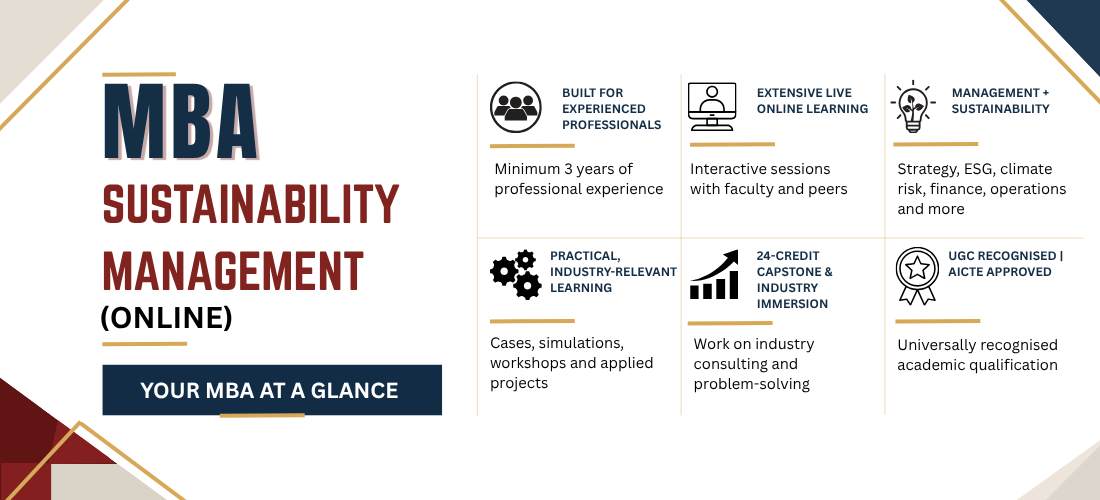
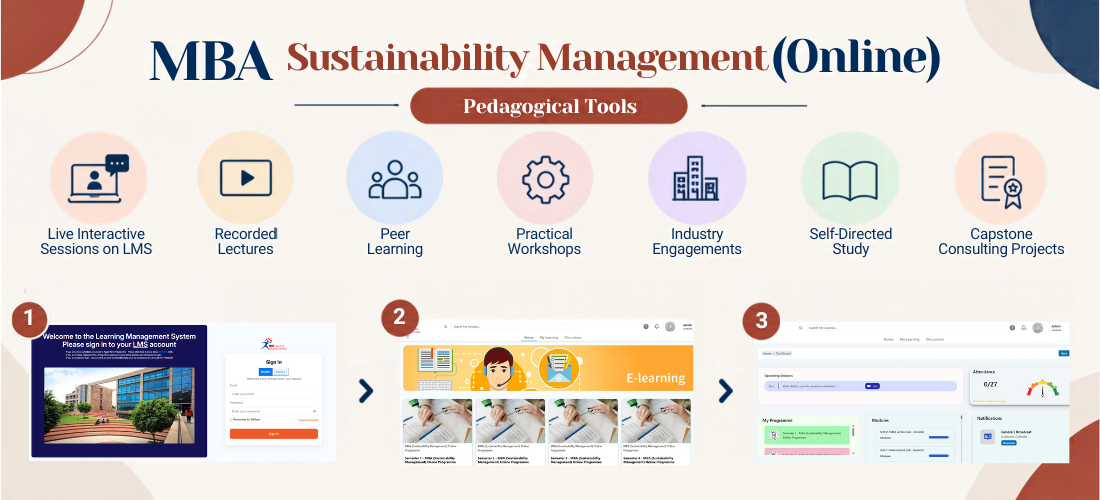
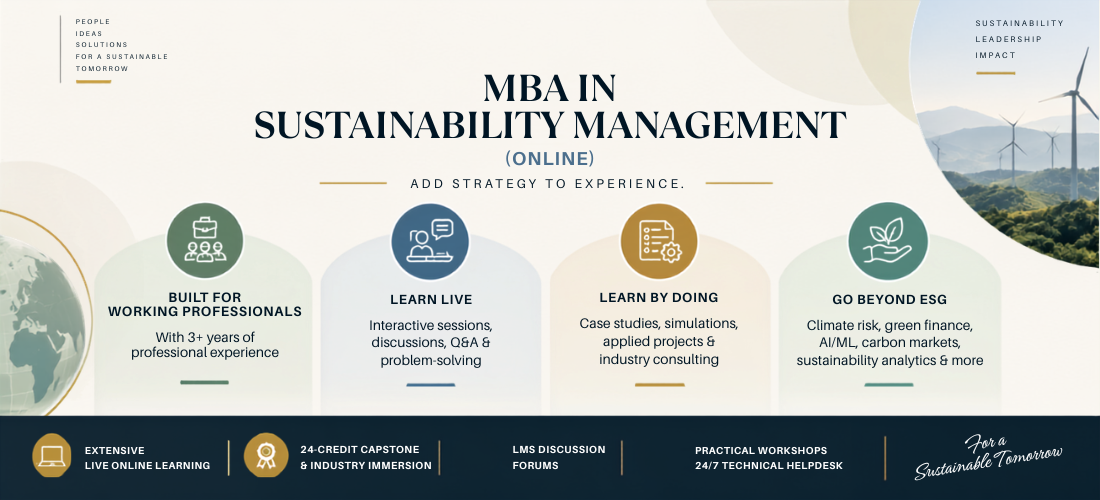
The programme MBA in Sustainability Management (Online) is closely aligned with the TERI School of Advanced Studies (Deemed to be University) mission of providing quality, accessible, industry-relevant, and socially responsible higher education that contributes to sustainable development and nation-building. The programme integrates contemporary management education with sustainability, ESG, climate change, responsible business, circular economy, sustainable finance, and environmental governance, thereby preparing working professionals to address emerging business and societal challenges. Its online mode of delivery expands access to advanced management education for professionals across geographical locations, enabling them to pursue higher education while continuing their careers. Through case-based learning, industry-oriented projects, applied research, experiential learning, and technology-enabled pedagogy, the programme seeks to develop responsible and ethical business leaders capable of integrating sustainability into organizational strategy and decision-making. In this manner, the programme contributes to the University’s commitment to academic excellence, lifelong learning, innovation, responsible leadership, and inclusive and sustainable development.
• To develop comprehensive knowledge of sustainability management, ESG principles, climate change, responsible business practices, environmental governance, and sustainable development.
• To develop strategic and analytical capabilities for integrating sustainability considerations into business strategy, operations, supply chains, finance, risk management, and organizational decision-making.
• To develop ethical and responsible leadership capabilities for managing organizational transformation, stakeholder interests, climate risks, and emerging sustainability challenges.
• To enable learners to apply sustainability concepts, frameworks, and tools to real-world organizational challenges and create inclusive, resilient, and sustainable value across business, government, consulting, and development sectors.
Upon successful completion of the MBA in Sustainability Management, graduates will be able to:
• Integrate ESG principles, climate risk considerations, and circular economy thinking into business strategy and organizational decision-making.
• Apply competencies in ESG reporting and disclosure frameworks, including GRI, SASB/ISSB, TCFD, and BRSR, along with green finance, carbon accounting, and sustainability governance practices.
• Apply sustainability knowledge and analytical skills to real-world organizational challenges through case-based, project-based, and industry-oriented learning and consulting assignments.
• Demonstrate the professional, strategic, and leadership competencies required to contribute effectively to sustainability-related roles across corporate, consulting, government, NGO, and development sectors.
Graduation with a minimum of 50% marks and a minimum of three years of professional experience. Internship experience will not be considered toward the required professional experience.
Selection of each candidate shall be done as per process and procedures followed at TERI School of Advanced Studies through "TERI SAS admission portal".

A limited fee waiver of 15% on tuition fees may be offered to eligible candidates based on the outcome of the interaction/screening process. This special inaugural fee benefit is applicable to candidates who complete their admission on or before 15 November 2026, subject to applicable eligibility criteria and institutional norms.
| Semester | Credits | Learning Hours | Duration* |
| First Year | |||
| Semester 1 - Foundation Core Modules | 20 | 600 | 24 weeks |
| Semester 2 – Advanced Core Modules | 20 | 600 | 24 weeks |
| Second Year | |||
| Semester 3 – Specialization & Electives | 24 | 720 | 24 weeks |
| Semester 4 – Capstone & Industry Immersion | 24 | 720 | 19 Weeks |
Note: One credit represents 30 notional learning hours. Notional learning hours include guided learning, self-learning, preparation, participation in learning activities, assignments, projects, and assessment related learner effort, as applicable.
| Course No. | Course Title | Type | Credit |
| Semester 1 | |||
| MBS 101 | Management Principles and Practices | Core | 2 |
| MBS 102 | Sustainability Economics & Green Markets | Core | 2 |
| MBS 103 | Principal Concepts of Sustainability | Core | 2 |
| MBS 104 | Business Research Methodology | Core | 2 |
| MBS 105 | Managerial Accounting for Sustainability | Core | 2 |
| MBS 106 | ESG Reporting | Core | 2 |
| MBS 107 | Marketing Management | Core | 2 |
| MBS 108 | Sustainable Supply Chain Management | Core | 2 |
| MBS 109 | Sustainable Branding | Core | 2 |
| MOOC Course | Suggestive Course Bucket • Quantitative and Mixed Methods Research for Management(Swayam) • Applied Business Statistics (Swayam) • Python for Data Science (Swayam) |
Core | 2 |
| Semester 2 | |||
| MBS 201 | Corporate Finance for Sustainability | Core | 2 |
| MBS 202 | Green Finance and Sustainable Investing | Core | 2 |
| MBS 203 | Life Cycle Assessment & Life-Cycle Costing | Core | 2 |
| MBS 204 | Project Management | Core | 2 |
| MBS 205 | Management Information Systems | Core | 2 |
| MBS 206 | AI & ML for Business Sustainability | Core | 2 |
| MBS 207 | Organization Change Management | Core | 2 |
| MBS 208 | Organisational Behaviour | Core | 2 |
| MBS 209 | Organisational Behaviour | Core | 2 |
| MOOC Course | Suggestive Course Bucket • Sustainable Business Management: Strategies to Build Green Enterprises (Swayam) • Strategy and the Sustainable Enterprise (Swayam) • Social Entrepreneurship and Sustainability (Swayam) |
Core | 2 |
| Semester 3 | |||
| MBS 301 | Circular Economy Strategy and Business Models | Elective (Track A) | 3 |
| MBS 302 | Environmental Footprinting | Elective (Track A) | 3 |
| MBS 303 | Zero Waste Management and Industrial Symbiosis | Elective (Track A) | 3 |
| MBS 304 | Sustainable Innovation and Entrepreneurship | Elective (Track A) | 3 |
| MBS 311 | Energy Transition and Renewable Systems | Elective (Track B) | 23 |
| MBS 312 | Climate Risk & Scenario Analysis | Elective (Track B) | 3 |
| MBS 313 | Social Entrepreneurship and Impact Investing | Elective (Track B) | 3 |
| MBS 314 | Diversity, Equity and Inclusion | Elective (Track B) | 3 |
| MBS 321 | ESG Ratings, Frameworks and Disclosure | Elective (Track C) | 3 |
| MBS 322 | Climate Finance and Carbon Markets | Elective (Track C) | 3 |
| MBS 323 | Sustainable Analytics and Business Intelligence | Elective (Track C) | 3 |
| MBS 324 | Environmental Law, Compliance and Governance | Elective (Track C) | 3 |
| Semester 4 | |||
| MBS 401 | Industry Consulting Project - Problem Scoping & Analysis | Core | 6 |
| MBS 402 | Industry Consulting Project - Solution Development & Implementation | Core | 6 |
| MBS 403 | Capstone Report Writing and Presentation | Core | 6 |
| MBS 404 | Industry Seminars, Expert Mentorship and Viva Voce | Core | 6 |
Plot No. 10, Institutional Area, Vasant Kunj, New Delhi - 110 070, India.
Tel. +91 11 71800222 (25 lines).
Website : www.terisas.ac.in
Email id : registrar@terisas.ac.in
© Copyright © 2026, TERI SAS, All rights reserved.
Visitors No.: 132505646 Since 2023